Key takeaways
- Educated medieval Europeans overwhelmingly knew the Earth was a sphere.
- The flat-Earth story was popularised in the nineteenth century, not the fifteenth.
- Columbus’s critics argued about the size of the Earth, not its shape.
- Myths about the past often say more about the people telling them.
It is a favourite punchline: medieval people, cowering in their ignorance, believed the world was flat until Columbus sailed off the edge of the map and proved them wrong. It is vivid, it is funny, and it flatters everyone alive today. It is also, almost entirely, invented.
The story we were told
In the popular version, the Church held back geography for a thousand years. Learned men at Salamanca ridiculed Columbus for risking a fall from the edge of the world, until his voyage in 1492 triumphantly disproved them. The tale turns the Middle Ages into a foil for the modern age and Columbus into its first hero.
What medieval scholars knew
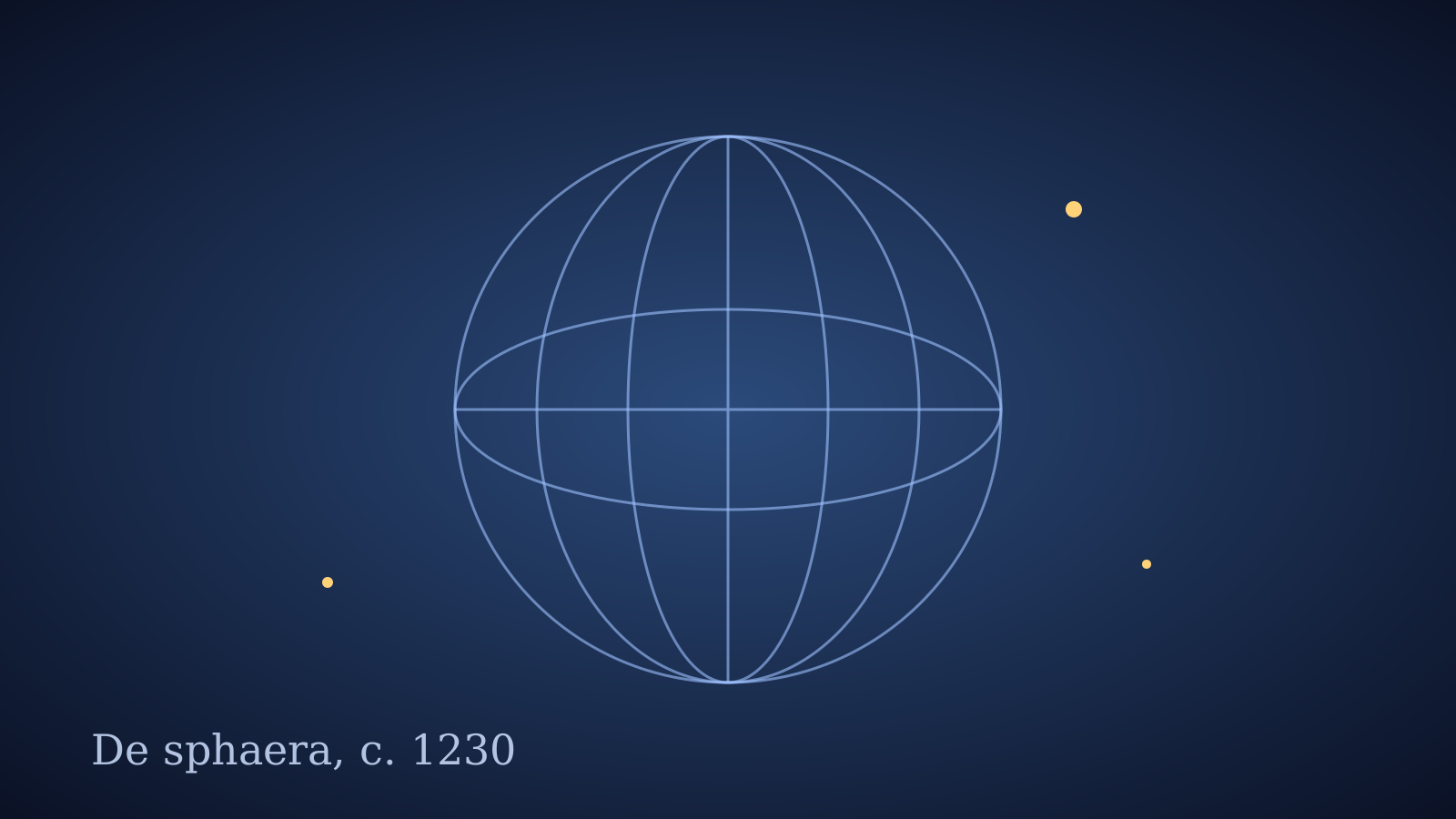
The sphericity of the Earth was established by Greek thinkers centuries before, and Eratosthenes made a famous estimate of its circumference around 240 BCE. Medieval scholars inherited that knowledge. The Venerable Bede wrote of a round Earth in the eighth century. In the thirteenth century, a short textbook called De sphaera by John of Sacrobosco became a standard text in European universities, teaching students that the Earth is a sphere at the centre of the cosmos. Thomas Aquinas, Dante and countless others take it for granted.
There were exceptions. A few early Christian writers, such as Lactantius and, later, Cosmas Indicopleustes, argued for a flat or boxlike world. They were marginal then, and the learned tradition did not follow them.
What Columbus’s critics really argued
The real dispute in the 1480s and 1490s was about distance. Columbus argued that Asia lay a short voyage west of Europe. His learned critics, using better estimates of the Earth’s size, said the journey was far longer than any ship could survive. They were right. Columbus was saved from disaster only by the existence of a continent neither side expected.
Who invented the myth, and why
The popular image took shape in the nineteenth century. Washington Irving’s lively 1828 biography of Columbus, which blended documented facts with imagined scenes, helped plant the picture of a council of ignorant churchmen. Later writers, notably John William Draper and Andrew Dickson White, built a broader story of perpetual war between science and religion, and the flat-Earth tale became its best-known exhibit. The myth served an argument about the present, not a record of the past.
Editorial assessment
The truth is humbler and more impressive. Medieval scholars, working with limited instruments and inherited texts, held a broadly correct picture of the planet and argued carefully about its size. The myth survives because it is flattering: it makes us look wise by comparison. A better habit is to ask who benefits when the past is made to look foolish, and what that story is being used to prove today.
Questions to think about
- Why was the flat-Earth story so attractive to nineteenth-century writers?
- What other “backward past” stories might deserve the same scrutiny?
- How should we judge historical figures who were wrong about one thing but right about another?
Disagree? Say why in the discussion below. Good arguments change minds.
References and sources
- Jeffrey Burton Russell, Inventing the Flat Earth: Columbus and Modern Historians (Praeger, 1991)
- Ronald L. Numbers (ed.), Galileo Goes to Jail and Other Myths about Science and Religion (Harvard University Press, 2009)
- Edward Grant, Science and Religion, 400 B.C. to A.D. 1550 (Greenwood, 2004)
Discussion
Challenge the argument, not the person. Community guidelines